Data Products
Data products
Data products are reusable information capabilities formed from use cases, catalog evidence, and supporting datasets.
Open data for people and AI agents
A value-oriented view of the catalog with data products, use cases, graph resources and machine-readable assets for AI-native use.
Portfolio Overview
This value portfolio organizes the open data catalog into data products, use cases and connected knowledge. It helps people, organizations and AI agents find, understand and reuse data for public value.
AI Agent Experience
The front page exposes the operating capabilities that make the Ajman open-data preview portfolio inspectable, searchable, and standards-ready.
Structured JSON, YAML, and search resources expose portfolio evidence without screen scraping.
Agents can retrieve relationships, cite records, and explain why a data product exists.Objectives, use cases, KPIs, and information needs shape data products.
Review starts from government outcomes and decisions, then traces back to supporting datasets.Dataset relationships and gaps stay inspectable so people and agents can see evidence limits.
Scores, missing coverage, and weak signals remain visible instead of becoming hidden automation.Linux Foundation ODPS, ODPC, and ODPG-aligned exports give agents and people a common operating language.
Portfolio evidence can move from this view into standards-aware product and graph workflows.Portfolio Scale
Data Products
Data products are reusable information capabilities formed from use cases, catalog evidence, and supporting datasets.
Use Cases
These use cases show the strongest decision demand signals, where people can trace policy questions to data products and supporting dataset evidence.
Gaps
Evidence gaps show where data products, use cases, information needs, or source datasets have limitations to consider before relying on a portfolio recommendation.
Data Products
Selection
Summary
Evidence
Relationships
Products
Gaps
About
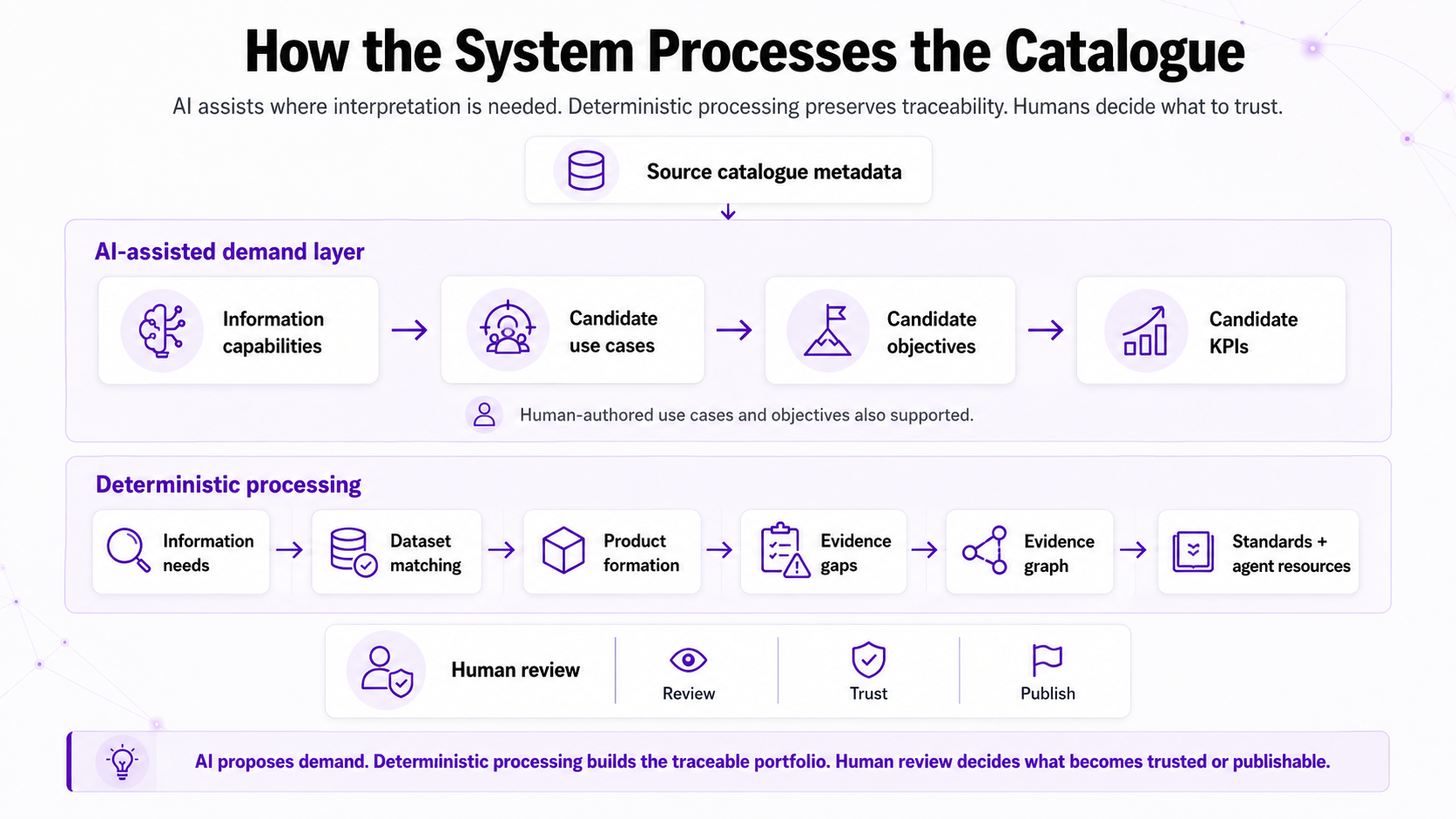
This explorer is the visible layer of a repeatable pipeline. A raw CSV catalogue dump is converted into normalized dataset records, enriched metadata, AI-assisted use cases and objectives, deterministic information needs, data products, review queues, standards exports, and graph artifacts that people and AI agents can inspect.
Source
The current source is https://data.ajman.ae/api/explore/v2.1/catalog/datasets. It is treated as raw catalogue metadata: titles, descriptions, publishers, domains, formats, and other source fields arrive from the dump and are preserved before downstream interpretation starts.
Processing
The pipeline validates and maps source columns, normalizes publishers, domains, and formats, enriches metadata with deterministic rules, discovers information capabilities, and then links demand back to datasets through explainable matching scores.
Flow
Use cases, objectives, KPIs, and information needs define demand. Data products are formed from recurring need clusters and supporting datasets, then sent through a review queue before they are eligible for default ODPS export.
LLM Usage
The LLM is used only in explicit generation commands for candidate use cases, business objectives, and KPIs. The source catalogue processing, information-need extraction, dataset matching, product formation, review queue generation, graph building, and standards exports remain deterministic and inspectable.
Standards
Approved products can be exported as ODPS 4.1 product documents. Generated objectives and use cases can be published as an ODPC 1.0 candidate catalog. The application graph uses a standards-aware vocabulary aligned toward ODPG and ODPV, while the current app graph remains the local exploration surface.
Agent Experience
The explorer publishes machine-readable resources beside the human interface: the full app graph, ODPG graph export, graph search index, enriched dataset metadata, source catalogue, and SDK link. Agents can retrieve, search, explain, and cite graph evidence without guessing how the screen is assembled.
Update
Replace or add the new CSV under source_data/, update the configured source path or default file name if needed, then rebuild the artifacts from the repository root. AI-backed generation is intentionally separate so a reviewer can decide when new candidate intent should be produced.
PYTHONPATH=src python3 -m open_data_value_graph.cli ingestPYTHONPATH=src python3 -m open_data_value_graph.cli build-allAI_ENABLED=true OPENAI_API_KEY=... PYTHONPATH=src python3 -m open_data_value_graph.cli generate-use-casesPYTHONPATH=src python3 -m open_data_value_graph.cli build-graphPYTHONPATH=src python3 -m open_data_value_graph.frontend_admin_server --port 8976Why this exists
Open-data catalogues are usually explored as inventories of files. This explorer takes the opposite approach: it starts from public-sector value creation, then connects objectives, use cases, information needs, data products, and source datasets into one inspectable evidence graph.
Value Perspective
The goal is not to list what data exists. The goal is to show what decisions, services, outcomes, and public value the data could support. A dataset becomes meaningful only when people can see the need it helps answer and the product opportunity it may enable.
Agent Experience
Ajman open-data preview is being prepared for AI-agent-enabled services. That means the portfolio cannot be only a human browsing interface. It must expose bounded, machine-readable graph resources so agents can search, reason, retrieve evidence, cite relationships, and explain recommendations without scraping the screen.
Admin
Maintain the demand signals that explain why data products should exist.
| Use case | Confidence | Products | Domains | Source | Actions |
|---|
Admin
Capture the decision need and domain context before the portfolio rebuild connects it to products.
Admin
Maintain the portfolio outcomes that group demand signals into reviewable public-value priorities.
| Objective | Confidence | Use cases | Domains | Source | Actions |
|---|
Admin
Capture the outcome, domains, and linked use cases before the portfolio rebuild updates graph evidence.
Created by
This portfolio explorer was created by Dr. Jarkko Moilanen to make open-data product opportunities visible as connected evidence: objectives, use cases, information needs, data products, datasets, standards exports, and agent-readable graph resources.
View LinkedIn profile
Focus
Connect policy objectives, use cases, information needs, data products, datasets, and standards outputs.
Method
Keep AI-generated suggestions bounded by deterministic graph resources, provenance, and review-ready records.
Standards
Shape the portfolio so reviewed data products can move toward standards-aware publication and automation.
Portfolio rebuild
Use case changes are being written to pipeline artifacts and derived evidence.
Product files
Building a ZIP package from the source files linked to this data product.
Show filters
The Records tab stays readable when the domain explorer shows four record types at a time. Clear one selection before adding another.